

This article is part of a 6-week introductory series, The Basics, covering all of the topics your conventional vet will try to sell you on, as preventive wellness. The choices you make regarding these topics will determine your pet’s future health trajectory.
Paid subscribers will receive an article once a week for 6 weeks covering a different topic that you can save, print, and share with pet-loving friends and neighbors.
At the end of the series, I will begin another series on preventive wellness from the perspective of Classical Chinese Medicine and the cycles that mirror the internal workings of the body with the external workings of the greater ecosystem we reside in, a true ecological medicine.
Flea and tick prevention is one of those areas where the conversation in most vet clinics goes something like this: ‘We recommend this product — here’s a year’s supply. Apply it whether you have fleas or ticks, every month, for the rest of your pet’s life.” Full stop.
One of my favorite questions to ask pharmaceutical reps is this: “You are telling me, the veterinarian, to recommend my clients give this product every month for the rest of the dog’s life. Have you tested it out to see if there are any side effects from giving it monthly, year after year after year?” They usually get very quiet and go give someone else their sales pitch.
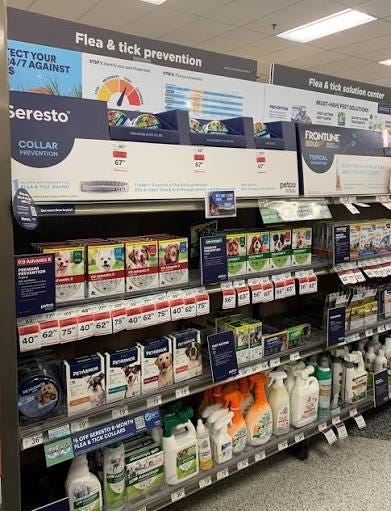
Giving these monthly would be fine if these products were harmless and had no side effects. But to kill an insect like a flea or an arachnid like a tick, it must be highly toxic, at least to the bug. When they are designing insecticides, they try to find a chemical or other substance that is more toxic to the target bug than to the mammalian species that also comes into contact with it.
Sometimes they succeed in finding something that will kill the insect quickly, but will take some time to build up in the mammalian body to cause harm over a longer time period.
As people who love our companion animals, we do not want to put anything toxic on or in them.
But we also do not want blood-sucking insects on them, making them uncomfortable and potentially giving them other serious diseases like Lyme.
So what can we do?
We need to understand the life cycle of the bugs and how we can stop them at each stage;
We need to provide layers of prevention, from the external terrain to the internal terrain;
We need to know what to use if we have to reach for a chemical preventative in a severe outbreak. And what to avoid at all costs.